
Swimming pool tiles: types, colours, the waterline, surrounds and how a pool is tiled
A guide to tiling a swimming pool, spa or water feature: which tile goes where, how tile colour sets the colour of the water, slip resistance around the pool, adhesive and grout, quantities and care.
A swimming pool is the hardest job a tile can be given. Tiles inside a pool stay under water all year, in contact with chlorine or salt, they expand and contract with the sun, and around the pool people walk barefoot on wet tiles. Get the choice and the fixing right and a tiled pool looks beautiful for decades; get either wrong and tiles loosen, grout washes out and the deck becomes slippery.
This guide explains how pool tiles are chosen for each part of a pool, how tile colour changes the colour of the water, what to ask about slip resistance, how a pool is tiled and how to look after it. It applies to home pools, villa and hotel pools, spas, plunge pools and water features.
The parts of a pool and what each needs
| Part | Conditions | What the tile needs |
|---|---|---|
| Shell (walls and floor) | Permanently under water, pool chemicals | Very low water absorption, chemical-resistant glaze, pool-grade fixing |
| Waterline band | In and out of water, sun, scale and oils | Stain-resistant, easy to clean, often a feature border |
| Steps and benches | Wet, walked on barefoot | Slip-resistant surface, a contrasting edge so steps are visible |
| Coping (the edge) | Sun, splashes, people sitting and stepping | Rounded or bullnose edge, slip-resistant, cool underfoot |
| Deck or surround | Wet feet, sun, furniture | Slip-resistant, light-coloured, frost-proof in cold climates |
| Water features, fountains | Splashes and running water | Glazed, low absorption, attractive close up |
Types of pool tiles
- Glass mosaic: small glass pieces, usually 20 to 25 mm, on mesh sheets. Absorbs almost no water, very colourful and reflective, ideal for curves. Many joints, so fixing takes time and skill.
- Porcelain mosaic and porcelain tiles: dense tiles that absorb almost no water, in small mosaic pieces or larger formats. Very durable, with matt and textured options for steps and floors.
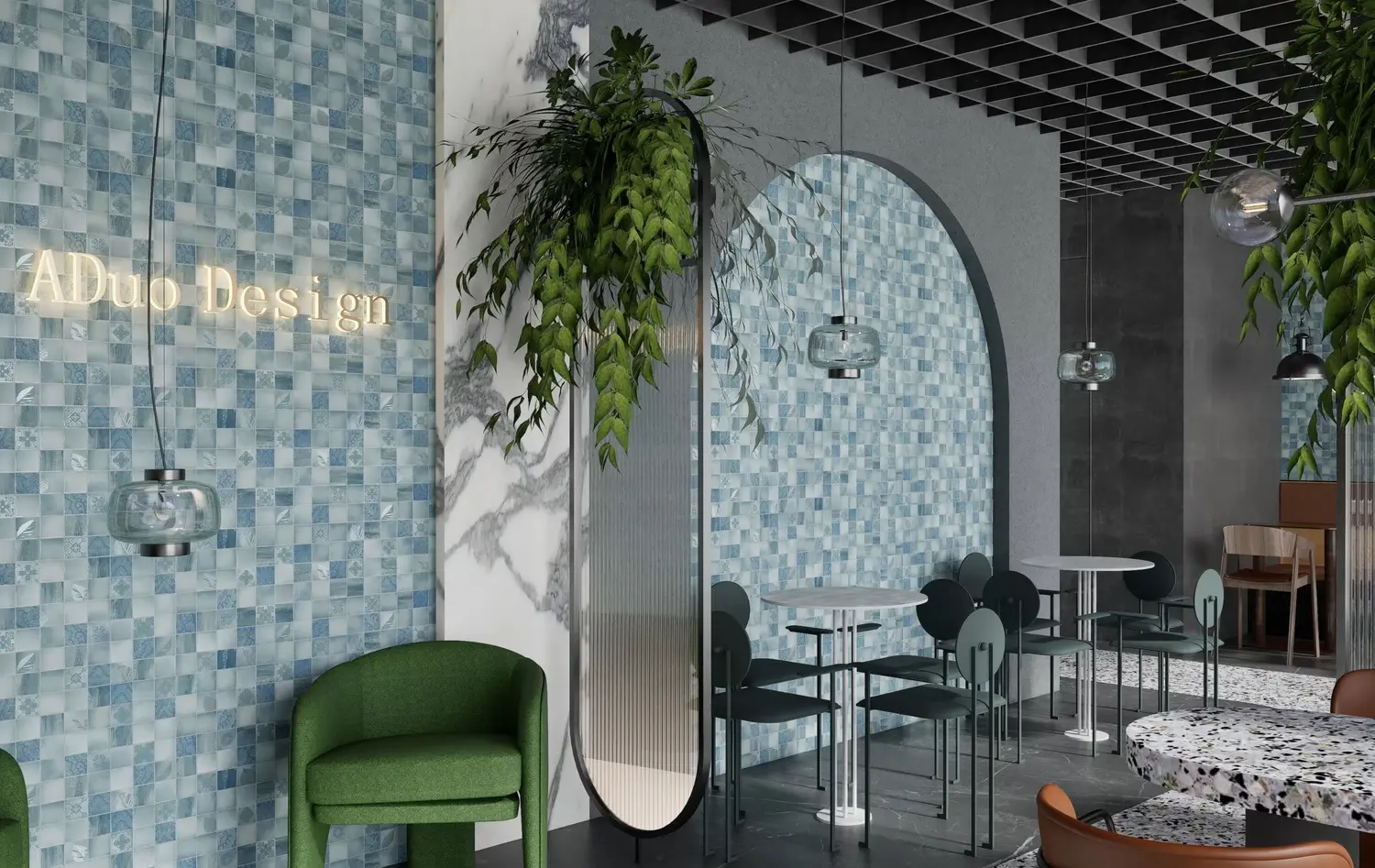
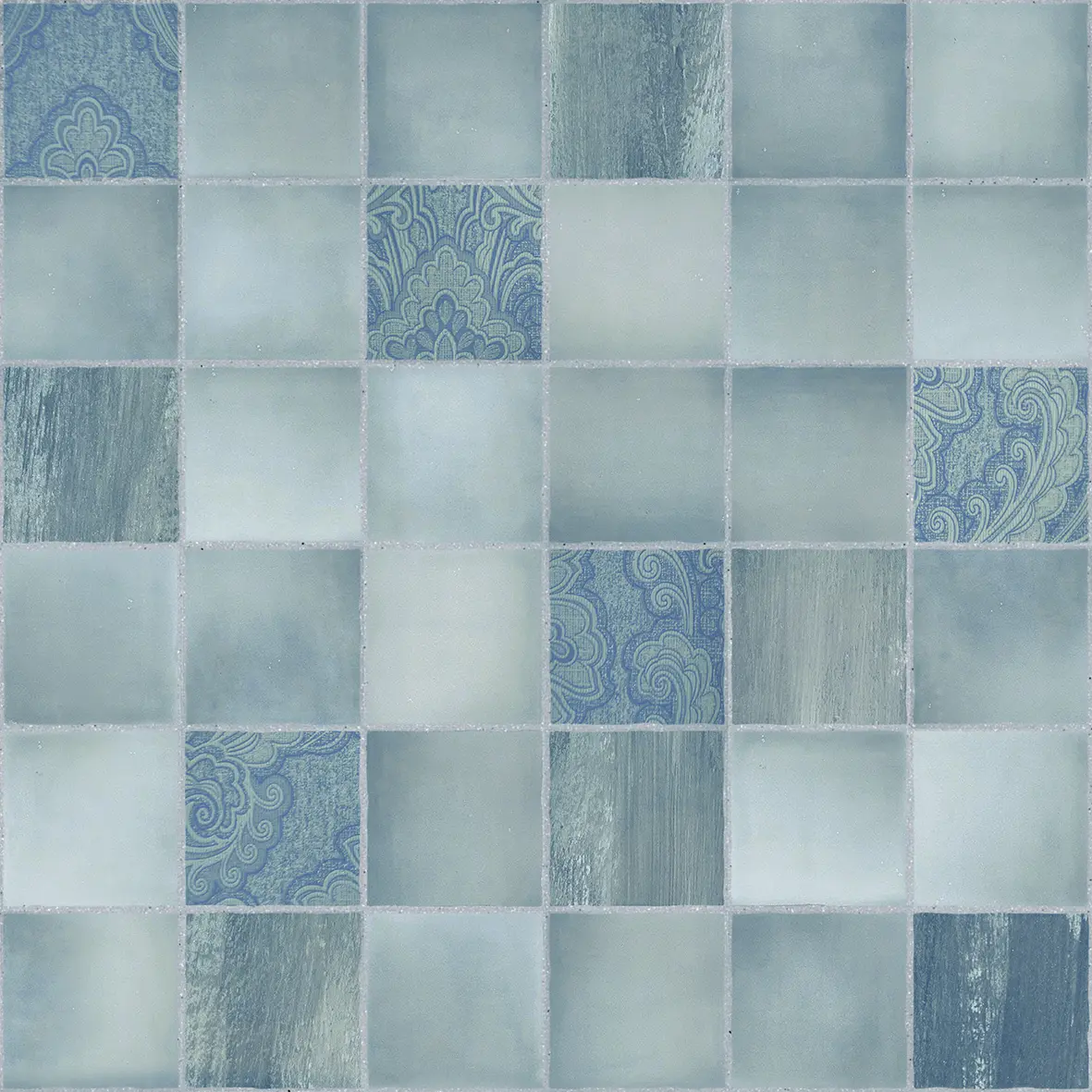
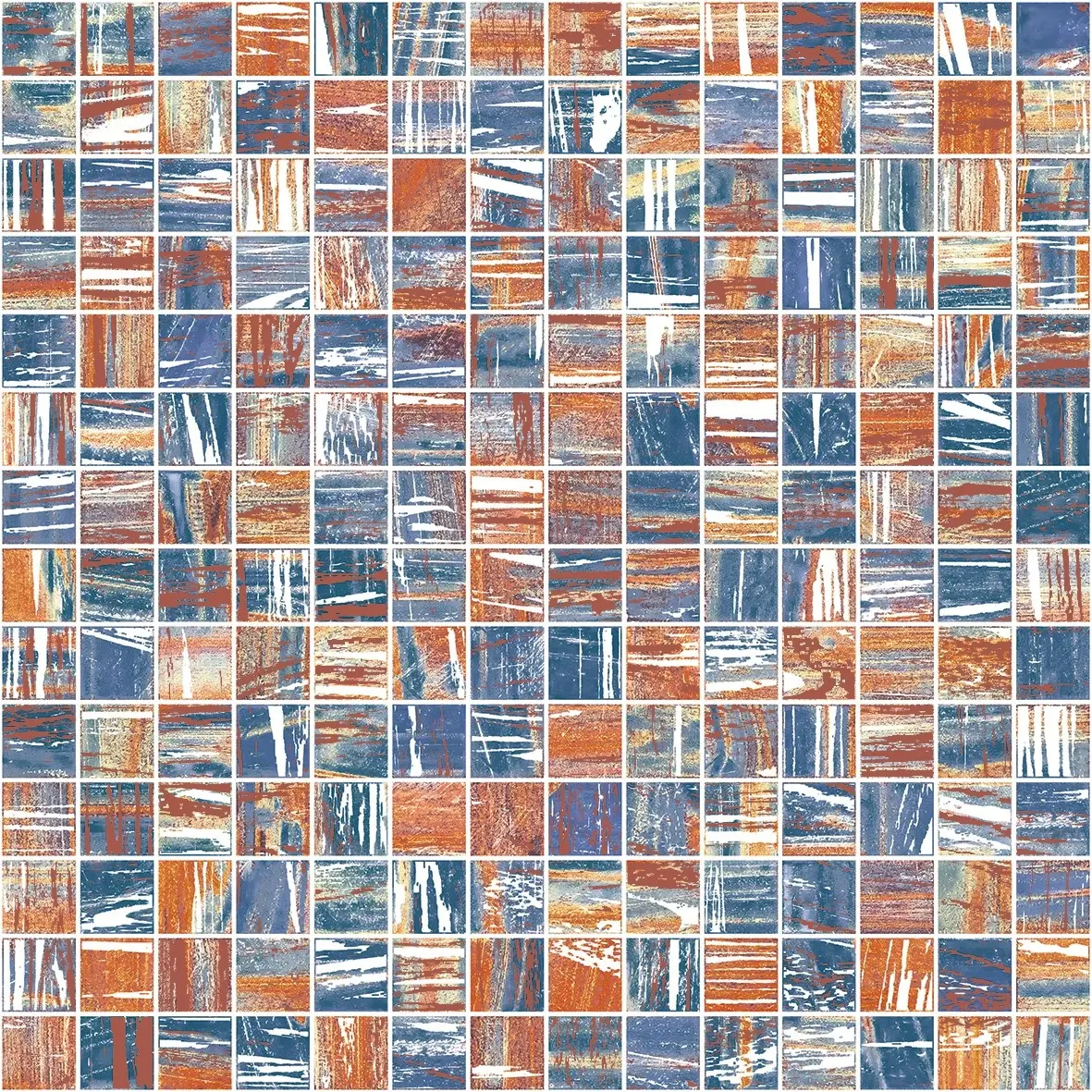
- Ceramic mosaic-look tiles: a mosaic pattern printed on a full-size glazed tile, giving the look of hundreds of small pieces with far fewer joints. Our Coliseo Azure is one: soft blue squares in several shades, some with a damask pattern, on a 300 × 300 mm tile.
- Natural stone: used for coping and decks; needs sealing and can get hot in sun.
- Anti-slip deck tiles: textured porcelain or ceramic floor tiles made for wet, barefoot areas.
For a submerged area, ask the maker to confirm that the tile is suitable for permanent immersion and for your pool's water treatment. We do this for every pool order: tell us the pool's size and the areas to be tiled, and we will confirm the right design and fixing for each part.
How tile colour changes the water
The water itself is clear; the tiles and the sky give it its colour. Choosing the tile colour is choosing the colour of the pool.
| Tile colour | Water looks |
|---|---|
| White and very light blue | Pale, crystal clear, like a shallow beach |
| Light and mid blue | The classic turquoise most people picture |
| Dark blue | Deep, rich blue, like the open sea |
| Green and sea green | Natural, like a lagoon or a lake |
| Grey and charcoal | Dark, reflective, modern, mirror-like on a calm day |
| Sand and beige | Warm, tropical, like a sandy shore |
The effect grows with depth: the deep end always looks darker than the shallow end. Light changes it too: water looks greener under a cloudy sky and bluer in strong sun. Before deciding, put a few sample tiles in a bucket of water and look at them outdoors in daylight. Our Coliseo Azure gives the soft turquoise of a resort pool.
Design ideas
- Resort turquoise: light blue mosaic-look tiles in the shell, a darker blue waterline band and white coping. Fresh and timeless.
- Natural lagoon: green and sand tones with stone coping and planting around the pool, for a pool that looks like a pond.
- Modern dark: charcoal or deep grey tiles for a mirror-like surface that reflects the sky and the house.
- Mediterranean: blue mosaic with a patterned border at the waterline and terracotta or stone around the deck.
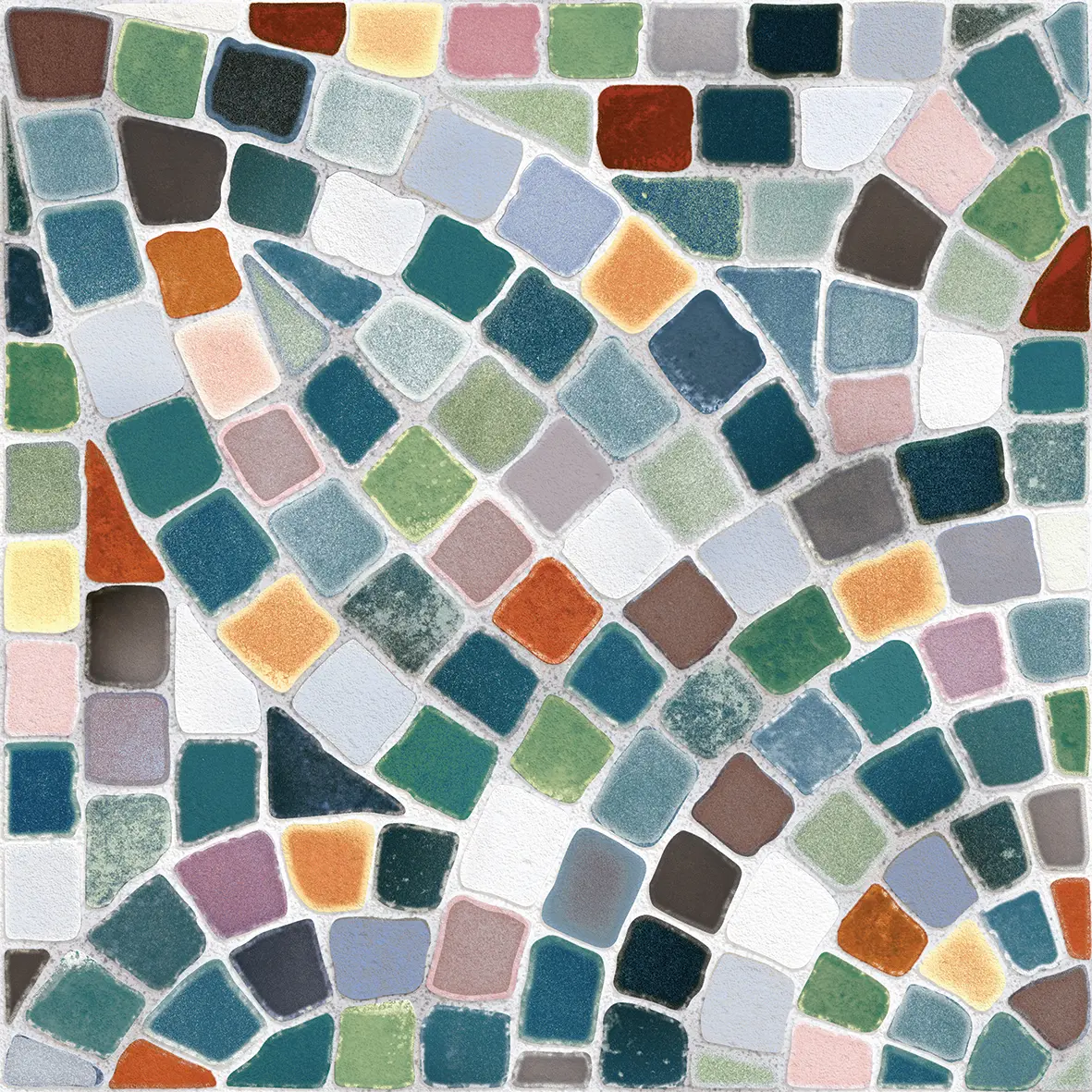
- Mosaic accents: a pattern on the steps, a mural on the floor of the deep end, or a contrasting stripe to mark lanes.
The waterline band
The band of tiles at water level, usually 150 to 300 mm deep, takes the most wear: it is wet and dry, in strong sun, and collects calcium scale, sunscreen and body oils in a visible line. It is often tiled in a darker or patterned border, which hides the line and frames the pool. Choose a glazed, stain-resistant tile with an epoxy grout here, and brush it every week.
Steps, benches and edges
Steps and benches are walked on barefoot under water, so they need a slip-resistant surface. Mark the front edge of each step with a contrasting colour tile so swimmers can see where the step ends; it is a simple safety measure, and in many countries a requirement for public pools.
Slip resistance around the pool
Barefoot wet areas have their own slip test. In Europe and much of the world, tiles for these areas are classed under DIN 51097 as A, B or C, with C the most slip-resistant: A for dry barefoot areas such as changing rooms, B for pool surrounds and showers, and C for pool steps and ramps that slope into the water. Ask for this rating, or the equivalent where you are, for any deck or step tile. Glossy tiles do not belong on a pool deck.
Light colours stay cooler underfoot in strong sun, which matters on an Indian or Gulf summer afternoon. Dark stone and dark tiles around a pool can become too hot to walk on.
How a pool is tiled
Pool tiling is specialist work. A good pool contractor will follow these steps:
- Shell and curing. The concrete shell is built, cured and checked for cracks.
- Waterproofing. A pool-grade waterproofing system is applied to the shell, with reinforcement at corners and around fittings, and tested by filling the pool before tiling.
- Levelling. The surface is rendered flat and true, so tiles sit evenly.
- Adhesive. A high-performance cement adhesive rated for permanent immersion (typically C2 class and deformable) is spread with a notched trowel; tiles are back-buttered for a full, void-free bed. Voids behind pool tiles fill with water and loosen tiles over time.
- Movement joints. Flexible joints at corners, changes of plane and at intervals across large areas allow for movement.
- Grout. Epoxy grout is used under water: it does not absorb water, resists pool chemicals and stays clean. Cement grout washes out and stains in a pool.
- Curing before filling. The adhesive and grout are left to cure for the full time their makers give, often a couple of weeks, before the pool is filled slowly.
Our installation guide explains the basics of adhesive and grout; for pools, always follow the adhesive and grout makers' pool instructions.
How many tiles for a pool
Add up the area of the pool floor, the walls and the steps. For a simple rectangular pool:
- Floor: length × width
- Walls: 2 × (length + width) × average depth
- Steps and benches: their treads and risers, measured separately
Example: a pool 30 × 15 ft, with an average depth of 4.5 ft:
- Floor: 30 × 15 = 450 sq ft
- Walls: 2 × (30 + 15) × 4.5 = 405 sq ft
- Total: 855 sq ft, plus 10% for cuts = 940.5 sq ft
- In 300 × 300 mm tiles (7 sq ft a box): 940.5 ÷ 7 = 134.4, so 135 boxes, plus the steps and the deck
Order the whole quantity at once, so every box is from the same batch, and keep a box or two of spares for repairs. Our tile calculation guide explains wastage and shade batches.
Pool tiles in different climates
- Hot, sunny climates (most of India, the Gulf, Africa): the deck and coping matter most. Choose light, matt, slip-resistant tiles that stay cool, and expect strong sun to bleach plastics and sealants faster; check movement joints yearly. Heat also speeds evaporation, so the water's mineral content rises and scale builds faster at the waterline.
- Monsoon and coastal climates: heavy rain dilutes the pool water and upsets its balance, and salty sea air settles on decks. Rebalance after storms, and rinse the deck with fresh water.
- Salt water pools: salt chlorinators are gentle on swimmers but salt crystals build on surfaces as water evaporates. Use epoxy grout and tiles confirmed for salt water.
- Cold climates: water that freezes inside a porous tile or grout cracks it. Use frost-proof tiles and protect or winterise the pool as the builder advises.
Pool houses, changing rooms and outdoor kitchens
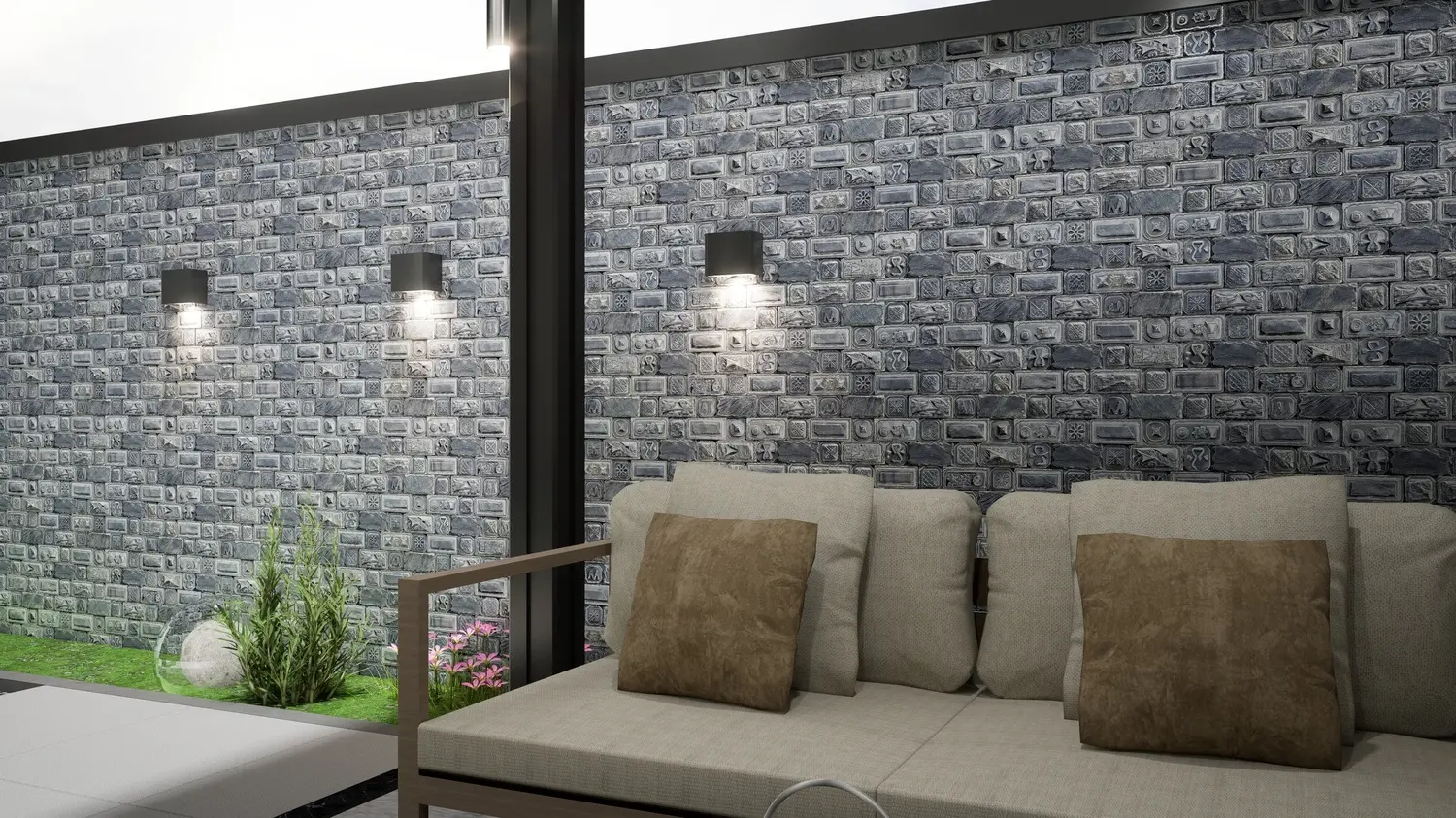
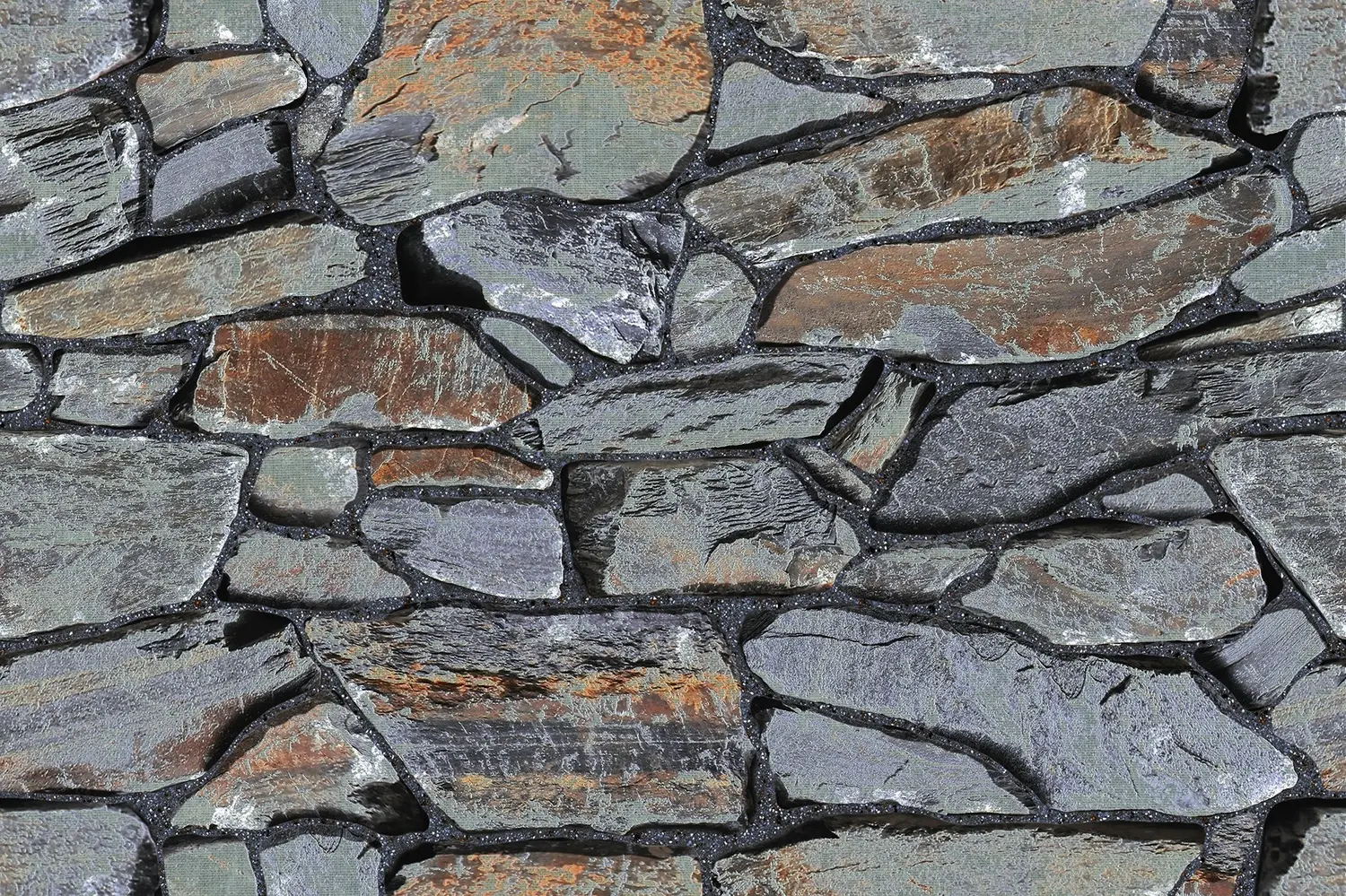
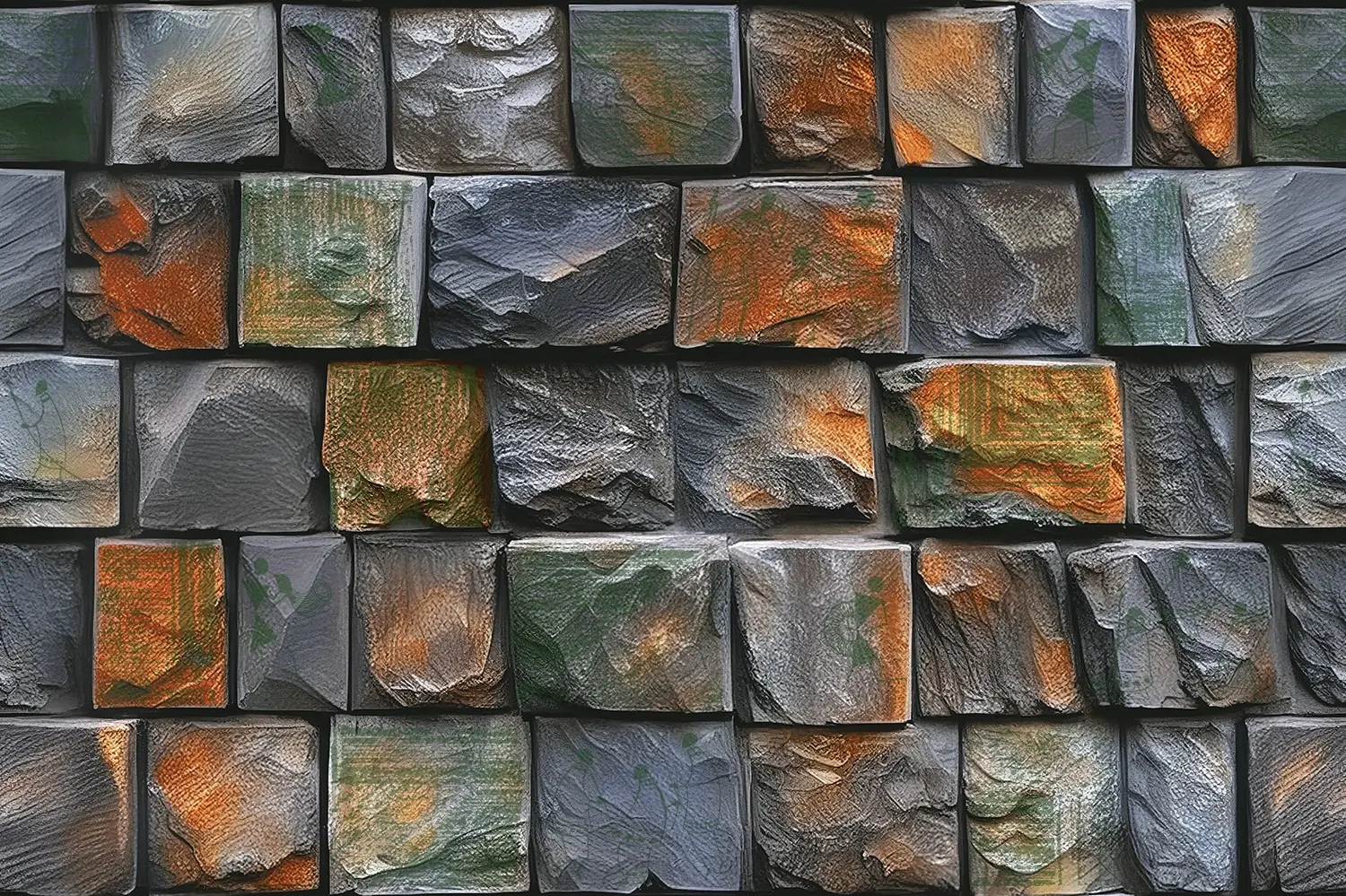
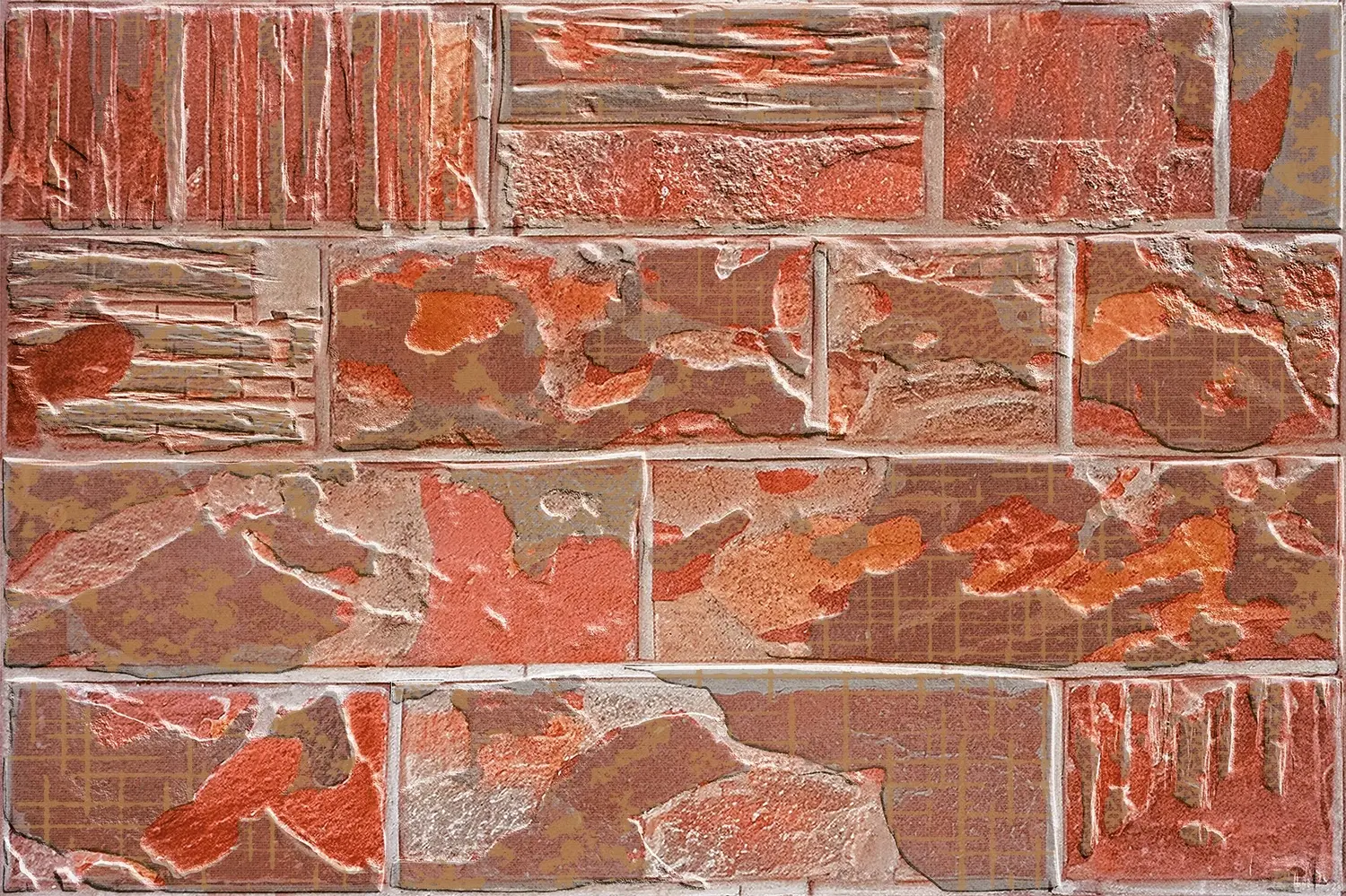
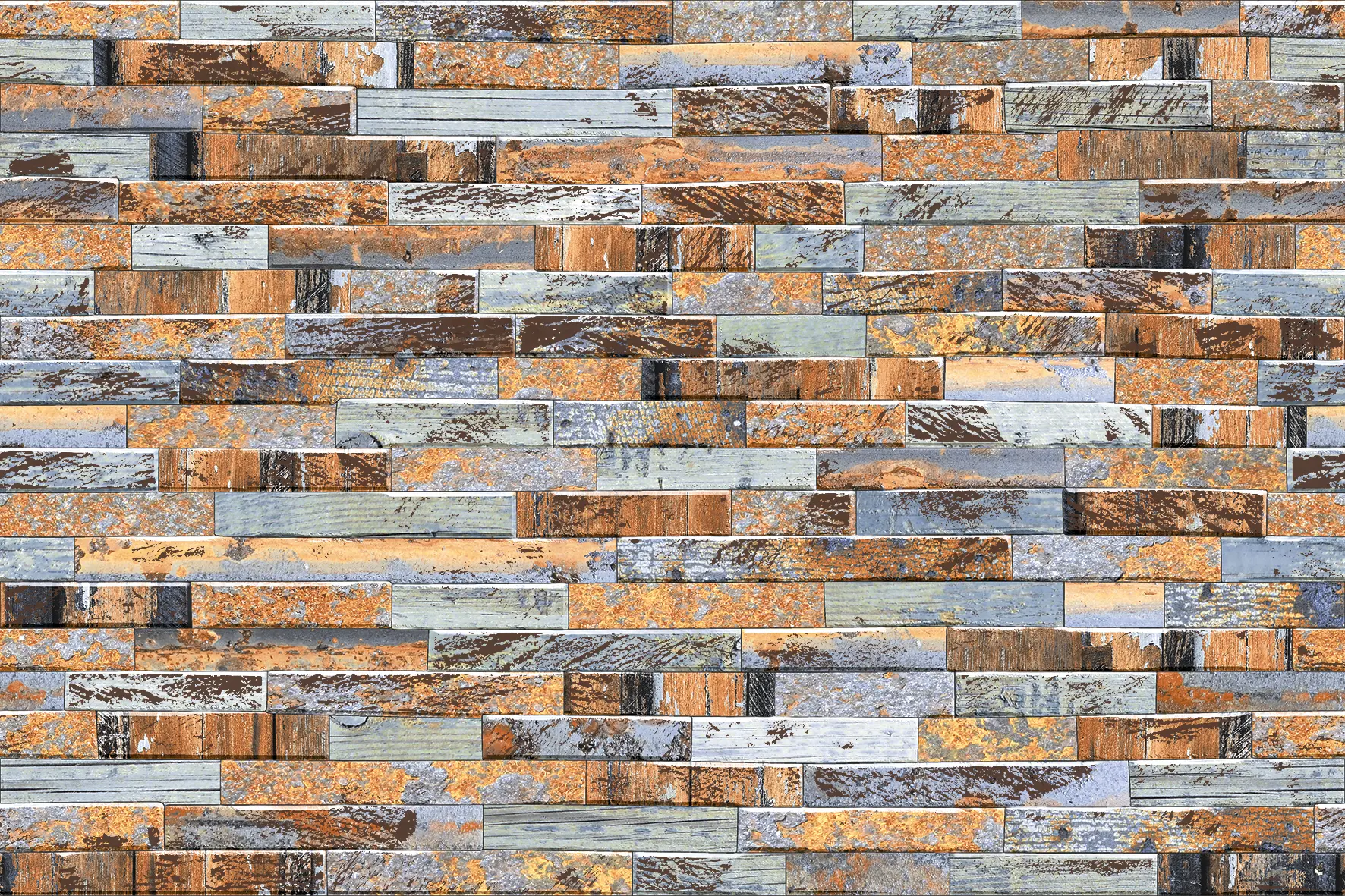
A pool rarely stands alone. Changing rooms and pool showers need slip-resistant floors and walls that shrug off water, like a bathroom. A bar or outdoor kitchen beside the pool suits a patterned or stone-look backsplash that is easy to wipe. Walls around the pool, such as a garden or boundary wall, look good in stone and slate looks such as Mudy Stone or Augitoo Art, shown on terrace walls around a fire pit. Tie them together by repeating one colour, for example the blue of the pool in a cushion, an umbrella or a tile band.
Mistakes to avoid
- Tiling over a shell that was never waterproofed or tested.
- Using ordinary tile adhesive or cement grout under water.
- Glossy tiles on steps, coping or the deck.
- Dark tiles around the pool in a hot climate, which get too hot for bare feet.
- No contrasting edge on steps.
- Filling the pool before the adhesive and grout have cured.
- Ordering in two lots, so the second batch does not match.
Spas, steam rooms and indoor pools
- Spa and jacuzzi walls: glazed tiles in calm blues, greens and stone looks, with epoxy grout.
- Steam rooms: fully waterproofed walls and ceiling, glazed tiles, epoxy grout, and a sloped ceiling so condensation runs off rather than drips.
- Indoor pools: good ventilation and dehumidification protect the building; tiles on the surrounding walls should be glazed and the floors slip-resistant.
- Showers by the pool: matt or textured floor tiles and easy-clean walls, as in a bathroom; see bathroom wall tiles.
Water features and fountains
Fountains, water walls and reflecting pools are a smaller version of the same job: a waterproofed base, glazed tiles that do not absorb water, pool-grade adhesive and epoxy grout. Because they are seen close up, a mosaic look or a patterned tile can be the star. A water wall in blue mosaic-look tiles makes a striking entrance for a hotel, a villa or a cafe courtyard.
Looking after a tiled pool
- Balance the water. Keeping pH, alkalinity and calcium hardness in the right range protects grout and stops scale; aggressive water eats grout, and hard water leaves scale on the tiles. Follow your pool supplier's guidance.
- Brush the waterline weekly to stop scale and oil building up, and use a cleaner made for pool tiles when needed.
- Avoid frequent acid washes, which wear grout and glazes.
- Inspect yearly for loose or hollow tiles, cracked grout and failed movement joints, especially when the pool is drained.
- Do not drain a pool for long in hot sun or frost without advice; the shell and tiles are designed to be under water.
For hotels, resorts and villa builders
Project buyers can ask for samples before the order, a box count for the whole pool and surrounds, and shade-matched supply from one batch. We supply hotel, resort and villa projects in India and abroad, including the Gulf, the Maldives and Sri Lanka; see our export pages, such as UAE, Maldives and Sri Lanka.
Pool area tiles from Axoli
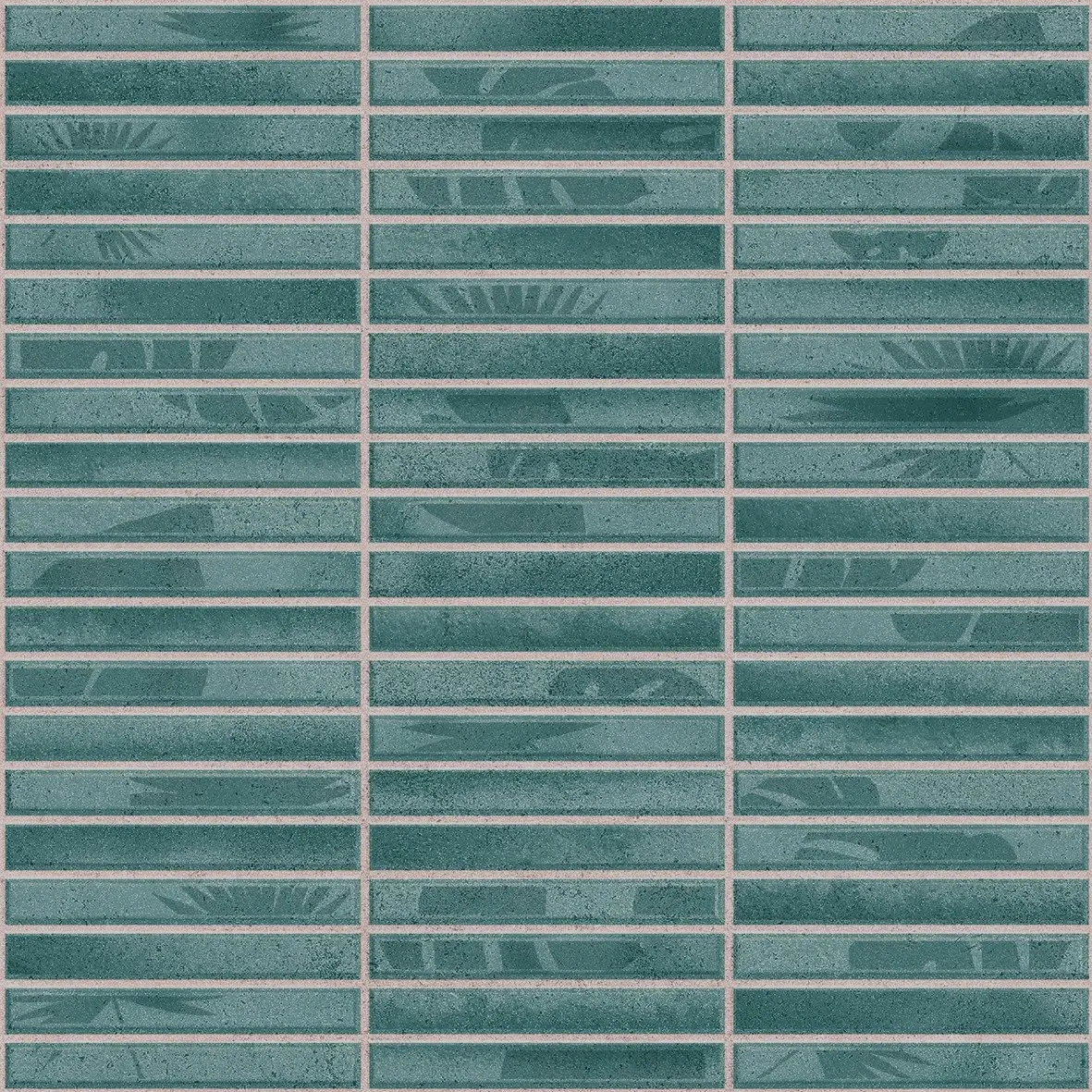
Our Pool Area collection is built around Coliseo Azure: a matt, 300 × 300 mm (12 × 12 inch) ceramic tile, 9.5 mm thick and rated for floors, in a blue mosaic look that gives water a soft turquoise colour. A box holds 7 tiles and covers 7 sq ft. It suits pool walls, steps, the waterline band, water features, spa and shower walls, and cafes that want a cool coastal look. For a submerged area, ask us before ordering so we can confirm the design and the fixing for your pool. For other blue and aqua looks, see Pigmento Aqua's teal strips.
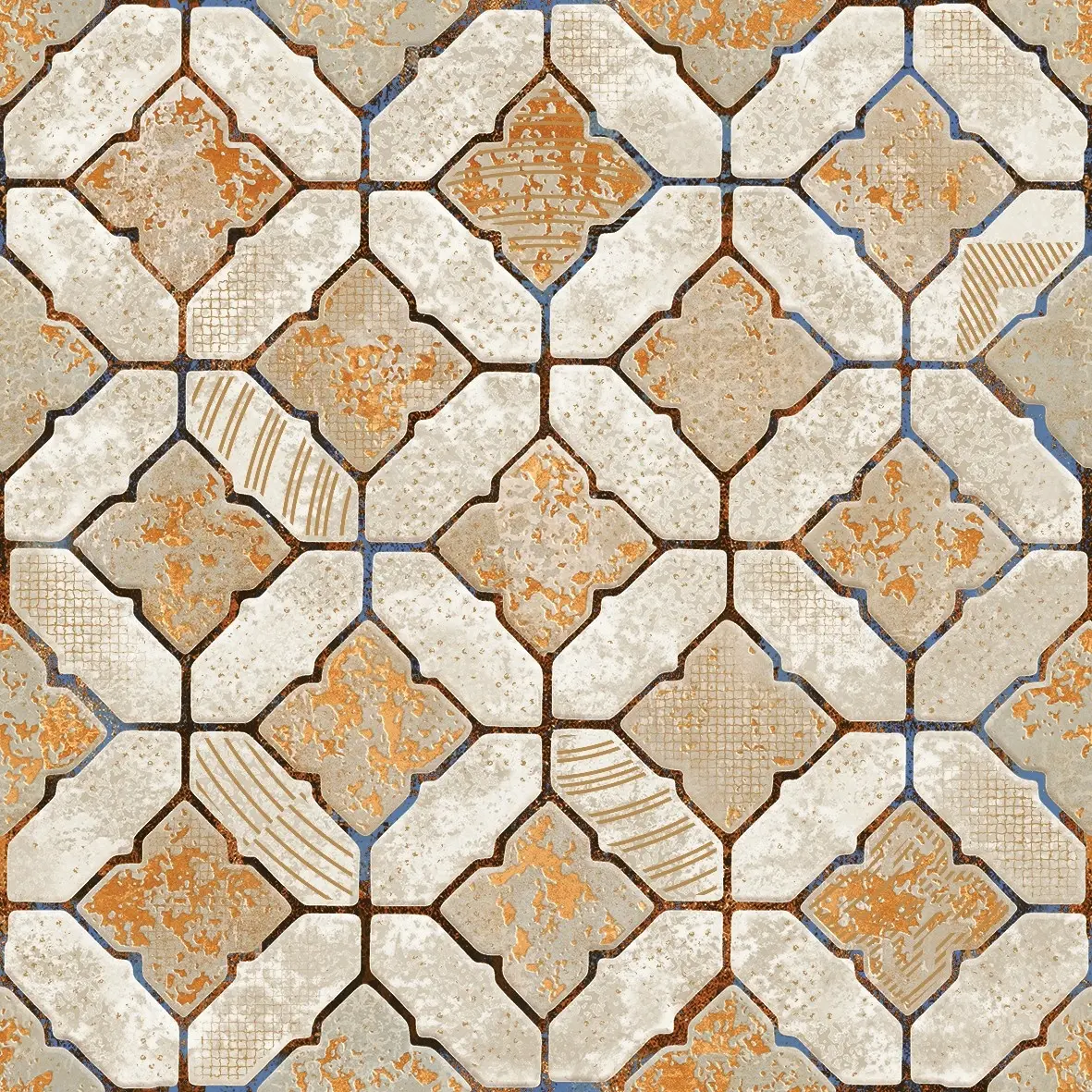
For patterned floors around a pool, terrace or patio, see Kolum Multi in our Signature Floor collection and the balcony and terrace tiles guide. Contact us with your pool's size for samples and quantities.
Pool tile ideas for small spaces
Not every pool is large. Plunge pools, rooftop pools, splash pools and reflecting pools in courtyards are increasingly common in Indian villas and city homes. In a small pool, a light blue mosaic look makes the water look clear and inviting, a darker colour makes it look deeper, and a patterned waterline band makes it look designed. A water wall or fountain in the same tile ties the pool to the garden.